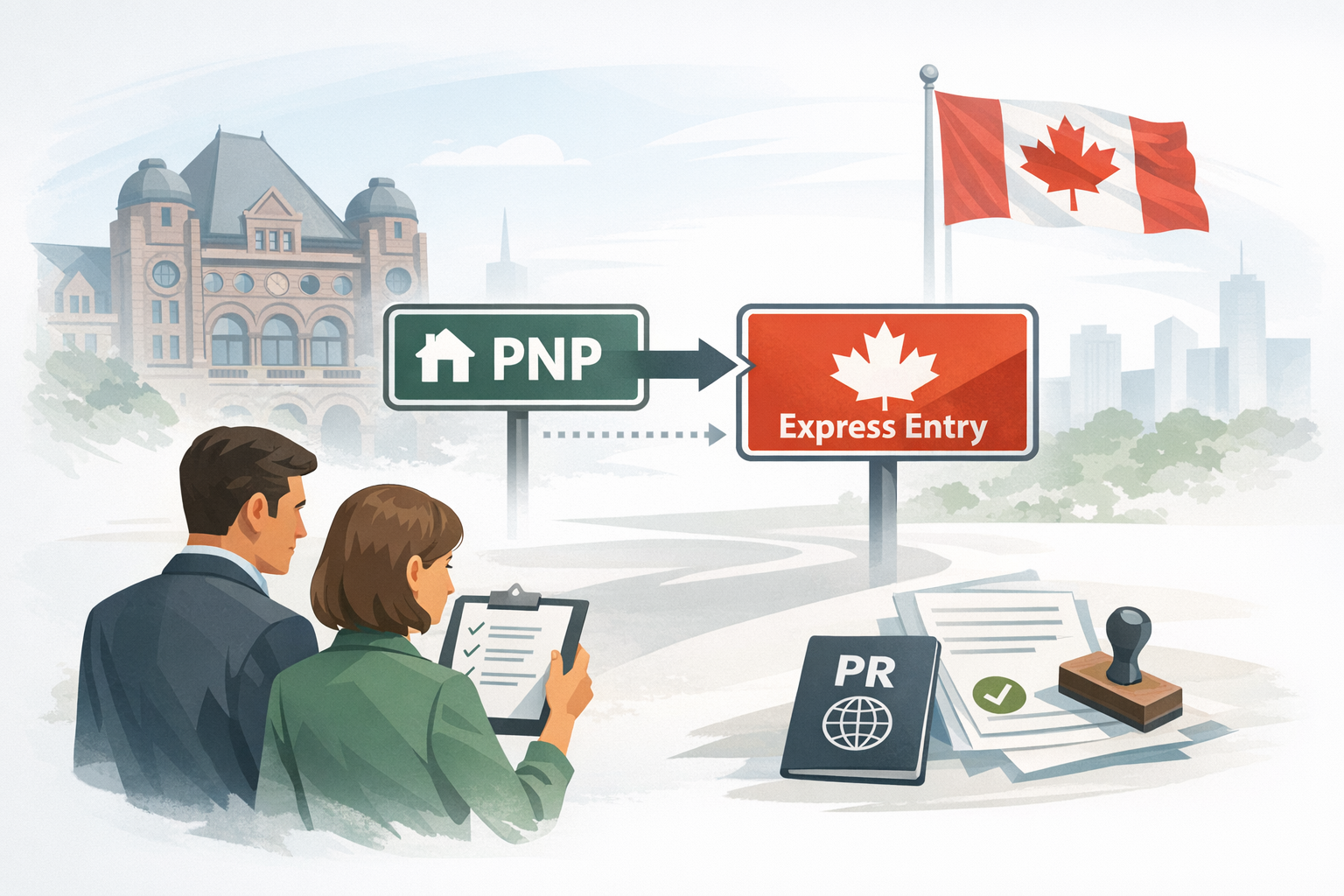
Ontario’s redesigned OINP Workforce Priority Stream lets eligible employer‑sponsored nominees with TEER 0–3 job offers elect an Express Entry–linked (enhanced) nomination instead of the base PNP. This can materially speed PR processing for candidates who maintain a valid Express Entry profile, but is limited to qualifying occupations and federal eligibility.
Soheil Hosseini
July 21, 2026
Jurisdiction
Ontario
Week
Week 30
Impact
Moderate
Programs Affected
Ontario allows eligible OINP nominees to use Express Entry, potentially speeding permanent residence processing
Summary: Ontario’s redesigned OINP now lets certain employer‑sponsored nominees channel their permanent residence applications through Express Entry rather than the slower base PNP route, potentially accelerating processing for qualified candidates in TEER 0–3 roles.
Date of update: 2026-07-21
Source: News Article; operational guidance referenced in the program update Ontario has introduced a significant procedural change to its Ontario Immigrant Nominee Program (OINP) that could shorten permanent residence timelines for many employer‑sponsored applicants. Under the redesigned framework, eligible nominees can opt to proceed via the federal Express Entry system, aligning Ontario more closely with other provinces that run “enhanced” nomination streams. What changed
- Previously, most employer job offer nominations in Ontario proceeded through the base Provincial Nominee Program (Base PNP), which is not linked to Express Entry and is typically slower.
- Under the redesigned Workforce Priority Stream, applicants with qualifying job offers in TEER 0, 1, 2, or 3 may indicate in their Ontario Expression of Interest that, if nominated, they wish to continue through Express Entry. The nomination can then support their Express Entry profile. Why it matters
- Shifting from base PNP to Express Entry–linked (enhanced) processing can materially reduce overall timelines for permanent residence.
- The move brings Ontario’s employer‑driven pathway closer to the model used by other provinces, adding flexibility and a potentially faster route to PR for eligible workers and their Ontario employers. Who is affected
- Applicants in the redesigned Workforce Priority Stream with qualifying job offers in TEER 0–3.
- Candidates who both receive an Ontario nomination and meet federal Express Entry eligibility, including maintaining a valid Express Entry profile. Key caveats
- The option does not apply to all OINP applicants; it is limited to the redesigned stream and eligible occupations.
- Using the enhanced pathway still requires meeting all federal Express Entry criteria.
- Program details may evolve; applicants should monitor official Ontario publications and federal guidance. Independent analysis: potential impacts
- Positive: Faster end‑to‑end processing for qualified candidates; improved employer recruitment and retention; better alignment with national selection systems; reduced backlog pressure in base PNP.
- Negative/risks: Applicants must remain competitive under Express Entry criteria; added complexity in maintaining valid profiles and meeting federal program thresholds; possible increased demand for limited nomination spots, intensifying competition.
Programs affected: OINP-JOFW, Express Entry, EE-PNP Closing
Ontario’s integration of an Express Entry option for eligible employer‑sponsored nominees is a consequential procedural upgrade that could streamline pathways to permanent residence. Stakeholders should confirm eligibility, ensure Express Entry readiness, and track official updates as implementation proceeds.
Tags: Canada immigration, Ontario Immigrant Nominee Program, OINP, Express Entry, Provincial Nominee Program, PNP, TEER 0–3, Workforce Priority Stream, employer job offer, permanent residence, PR processing times, EE-PNP, OINP-JOFW
Categories
Share This Post
Stay Updated with Immigration News
Get the latest updates on Express Entry draws, OINP invitations, policy changes, and more delivered to your inbox.
We respect your privacy. Unsubscribe at any time.
Related Articles

NOC 33102 Institutional Only
OINP confirms NOC 33102 applies only to nurse-aide roles primarily performed in institutional settings (hospitals, nursing homes, assisted-care and other health establishments); home-based care must be classified as NOC 44101. Employers and applicants should update job offers, contracts and postings to the correct NOC to avoid application delays or refusals.

FMCSP Renewal Rules
On 2026-09-24 IRCC updated the Francophone Minority Communities Student Pilot, adding financial requirements for study‑permit renewals and explicitly accepting valid LOAs or other proof of continued enrolment. The guidance also clarifies extension rules for accompanying family members and confirms participants retain FMCSP designation while meeting eligibility.

90-Day Grace Period
IRCC extends concurrent processing grace period for eligible in‑Canada LMIA‑dependent work‑permit extension applications from 60 to 90 days, holding applications without decision to allow a pending LMIA (and CAQ, if required) to be issued. A new client flagging process (use tracking code CPTS2026 in the intended occupation) identifies files for concurrent processing; eligibility hinges on permit expiry window, timely LMIA filing, and LMIA validity.

IRCC A70 Guidance
IRCC standardized and reorganized R207 – A70 guidance for in‑Canada PR applicants under the International Mobility Program—new landing page, clarified instructions and consistent format. Affects protected persons, family members and H&C applicants; procedural/formatting update only, no substantive eligibility changes.